


Feb 24, 2026
Measuring Organisational AI Maturity: A Practical Scoring Model

Testing Automation
Testing Automation enables faster, reliable, and repeatable validation of software through automated scripts and tools. It reduces manual effort, improves quality, accelerates releases, and supports continuous integration and delivery in modern digital transformation programmes.
Key Benefits of our Testing Automation approach
Testing automation integrates tools, frameworks, and scripts to validate applications across functional, regression, performance, and security layers. It supports CI/CD pipelines, ensures consistent quality checks, accelerates deployment cycles, and provides measurable test coverage and traceability for governance and compliance.
01
Automated Regression Testing
Automated regression suites ensure that new code changes do not negatively impact existing functionality. By running predefined test scripts repeatedly across builds, organisations reduce risk, improve reliability, and accelerate release confidence in complex digital ecosystems.
02
CI/CD Pipeline Integration
Testing automation integrates seamlessly into CI/CD pipelines, enabling continuous testing with every code commit. This ensures early defect detection, rapid feedback loops, and higher deployment frequency without compromising stability or compliance requirements.
03
Cross-Platform & Cross-Browser Testing
Automated frameworks validate applications across multiple browsers, devices, and operating systems. This ensures consistent user experience, reduces environment-specific defects, and supports global or multi-country digital rollout strategies.
04
Performance & Load Testing
Automation tools simulate high user traffic and stress conditions to evaluate system performance and scalability. This ensures applications remain responsive, secure, and stable under peak loads, especially critical in regulated and high-availability sectors.
05
Reporting & Analytics Dashboards
Real-time dashboards provide visibility into test coverage, defect trends, execution time, and quality KPIs. These insights support PMO governance, stakeholder reporting, and informed decision-making across IT and business leadership teams.
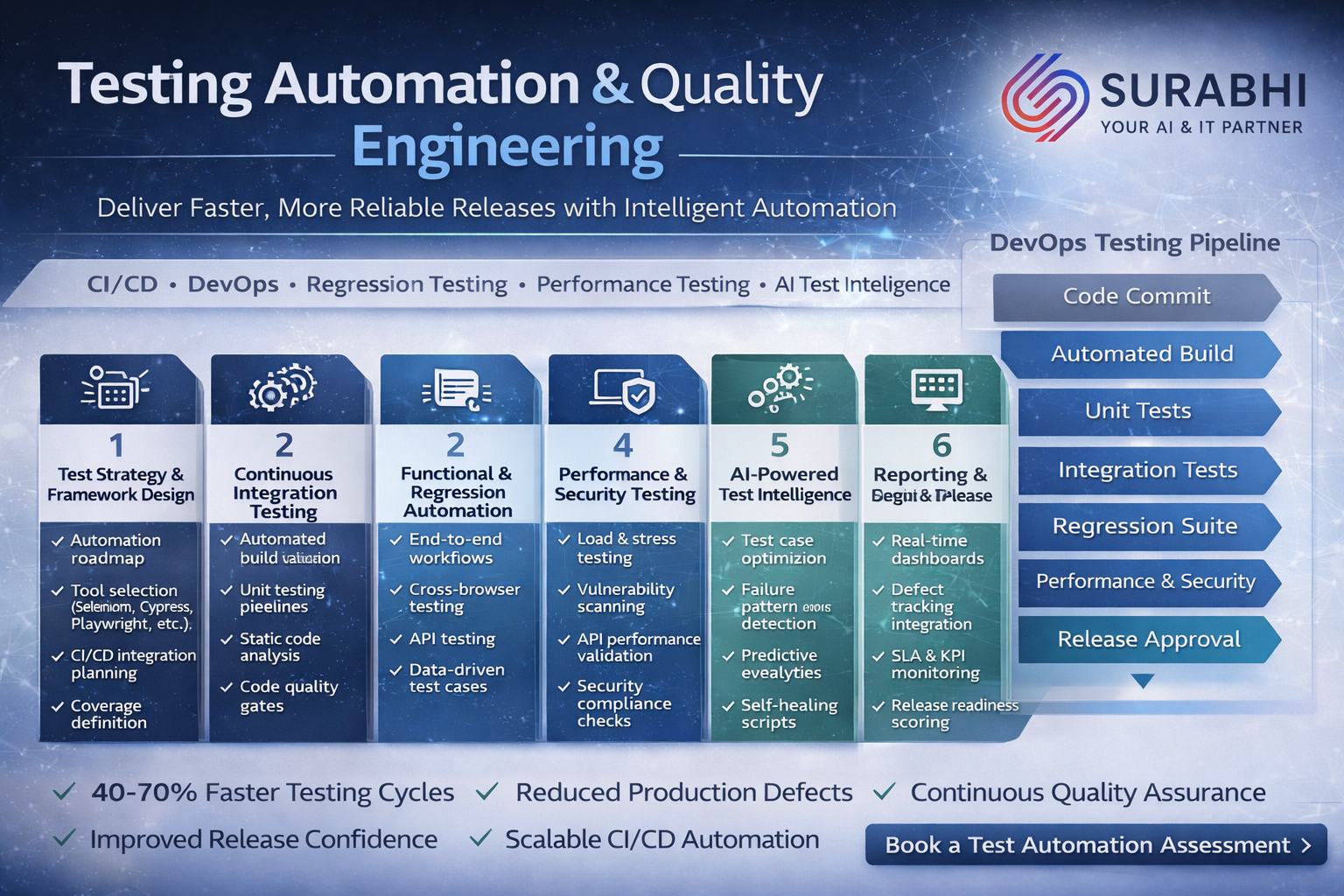
The Testing Automation Roadmap
Testing automation follows a structured approach that begins with requirement analysis and tool selection, followed by framework design and script development, and concludes with execution, monitoring, and continuous optimisation to enhance quality and delivery speed.
Step 01
Assessment & Automation Strategy
This phase involves analysing application architecture, business requirements, compliance constraints, and delivery models (Agile/Hybrid). Tools, frameworks, and test scope are defined, alongside governance controls, test coverage goals, and ROI expectations.
A scalable automation framework is designed using industry-standard tools and best practices. Test scripts are developed for functional, regression, integration, and performance scenarios. CI/CD integration is configured to enable automated execution across environments.
Automated test suites are executed regularly across builds and releases. Results are monitored via dashboards, defects are triaged, and scripts are optimised for maintainability. Continuous improvement ensures alignment with evolving business, regulatory, and technical landscapes.
FAQ – DevOps Engineering (Testing Automation)
How does testing automation support DevOps Engineering?
Testing automation is a core enabler of DevOps Engineering because it integrates directly into CI/CD pipelines, ensuring that every code commit is automatically validated. This reduces manual intervention, accelerates feedback cycles, improves release confidence, and enables frequent, reliable deployments without compromising quality or compliance.
What types of testing can be automated in a DevOps environment?
In a DevOps environment, functional, regression, integration, API, performance, and even security testing can be automated. Automated testing ensures consistent validation across environments, supports infrastructure-as-code models, and strengthens quality gates before production releases, especially in complex cloud-native ecosystems.
How does automated testing reduce project risk?
Automated testing reduces project risk by identifying defects early in the development lifecycle. Continuous validation prevents critical issues from reaching production, improves traceability, and provides measurable quality metrics. This proactive approach lowers rework costs and enhances stakeholder confidence.
Is testing automation suitable for regulated industries?
Yes, testing automation is highly suitable for regulated industries such as finance, healthcare, and public sector. Automated test logs, audit trails, and traceable reports support compliance requirements. Structured governance and documentation ensure alignment with regulatory standards and quality assurance frameworks.
What is the ROI of implementing testing automation?
The ROI of testing automation is achieved through faster release cycles, reduced manual testing effort, fewer production defects, and improved operational stability. Over time, automated regression suites significantly lower maintenance costs and support scalable digital transformation initiatives.