
Feb 24, 2026
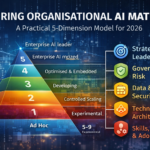
Measuring Organisational AI Maturity: A Practical Scoring Model

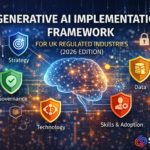
Generative AI Implementation
Generative AI implementation enables organisations to automate content creation, enhance decision-making, and improve customer engagement. It requires strong data governance, ethical safeguards, scalable cloud infrastructure, and clear business alignment to deliver measurable value and responsible innovation.
Key Benefits of our Generative AI Implementation approach
Generative AI features include automated content creation, intelligent document summarisation, code generation, conversational chatbots, personalised recommendations, workflow automation, predictive insights, multilingual support, and continuous learning capabilities—enabling faster decisions, improved efficiency, and enhanced customer engagement.
01
Automated Content Creation
Generates text, images, code, and reports instantly.
02
Intelligent Summarisation
Condenses large documents into clear insights.
03
Conversational AI
Enables smart chatbots and virtual assistants.
04
Personalisation Engine
Delivers tailored recommendations and responses.
05
Continuous Learning
Improves accuracy through ongoing model refinement.
The Generative AI Implementation Roadmap
Generative AI implementation begins with defining business use cases and preparing quality data. Models are then selected or trained, integrated into existing systems, and tested for accuracy, security, and bias. After deployment, performance is monitored and continuously improved to ensure scalable, responsible, and value-driven outcomes.
Step 01
Plan
Define objectives, identify use cases, assess data readiness, and set governance controls.
Step 02
Execution
Configure or train the model, integrate with systems, and conduct testing (accuracy, bias, security).
Step 03
Review
Deploy, monitor performance, manage risks, and continuously optimise for business value.
Frequently Asked Questions (FAQs) on Generative AI Implementation
What is Generative AI?
Generative AI uses advanced models to create text, images, code, and other content based on patterns learned from data.
How can Generative AI benefit my organisation?
It improves efficiency, automates workflows, enhances customer engagement, and supports faster, data-driven decision-making.
Is Generative AI secure and compliant?
With proper governance, data controls, and ethical safeguards, it can align with regulatory and security requirements.
What data is required to implement Generative AI?
High-quality, well-structured, and relevant data is essential for accurate and reliable outputs.
How long does implementation take?
Timelines vary by complexity, but pilot solutions can often be deployed within weeks, with phased scaling thereafter.