


Feb 24, 2026
Measuring Organisational AI Maturity: A Practical Scoring Model

Azure Migration
Azure Migration enables organisations to securely transition applications, data, and infrastructure from on-premise or legacy environments to Microsoft Azure, improving scalability, resilience, cost efficiency, compliance, and operational agility across the enterprise.
Key Benefits of our Azure Migration approach
Azure Migration combines structured assessment, secure cloud architecture design, automated migration tooling, and post-migration optimisation. It ensures business continuity, regulatory compliance, cost transparency, and performance scalability while modernising legacy systems into resilient cloud-native solutions.
01
Cloud Readiness Assessment & Discovery
Comprehensive evaluation of applications, infrastructure, dependencies, and workloads to determine migration suitability. Identifies risks, compatibility gaps, cost estimates, and transformation opportunities before execution begins.
02
Secure Architecture & Landing Zone Design
Design of Azure landing zones aligned with governance, security, and compliance standards. Includes identity management, network segmentation, RBAC controls, and policy enforcement to ensure secure cloud adoption.
03
Automated Migration & Tooling
Use of Azure-native tools such as Azure Migrate to streamline workload replication, database migration, and server transfer. Automation reduces downtime, minimises manual errors, and accelerates delivery timelines.
04
Data Protection & Compliance Management
Implements encryption, backup, disaster recovery, and monitoring aligned with UK and global regulatory requirements. Ensures data sovereignty, audit readiness, and business continuity throughout the transition.
05
Optimisation & Modernisation Strategy
Post-migration performance tuning, cost optimisation, and transformation into PaaS or cloud-native architectures. Enables scalability, automation, DevOps integration, and long-term operational efficiency.
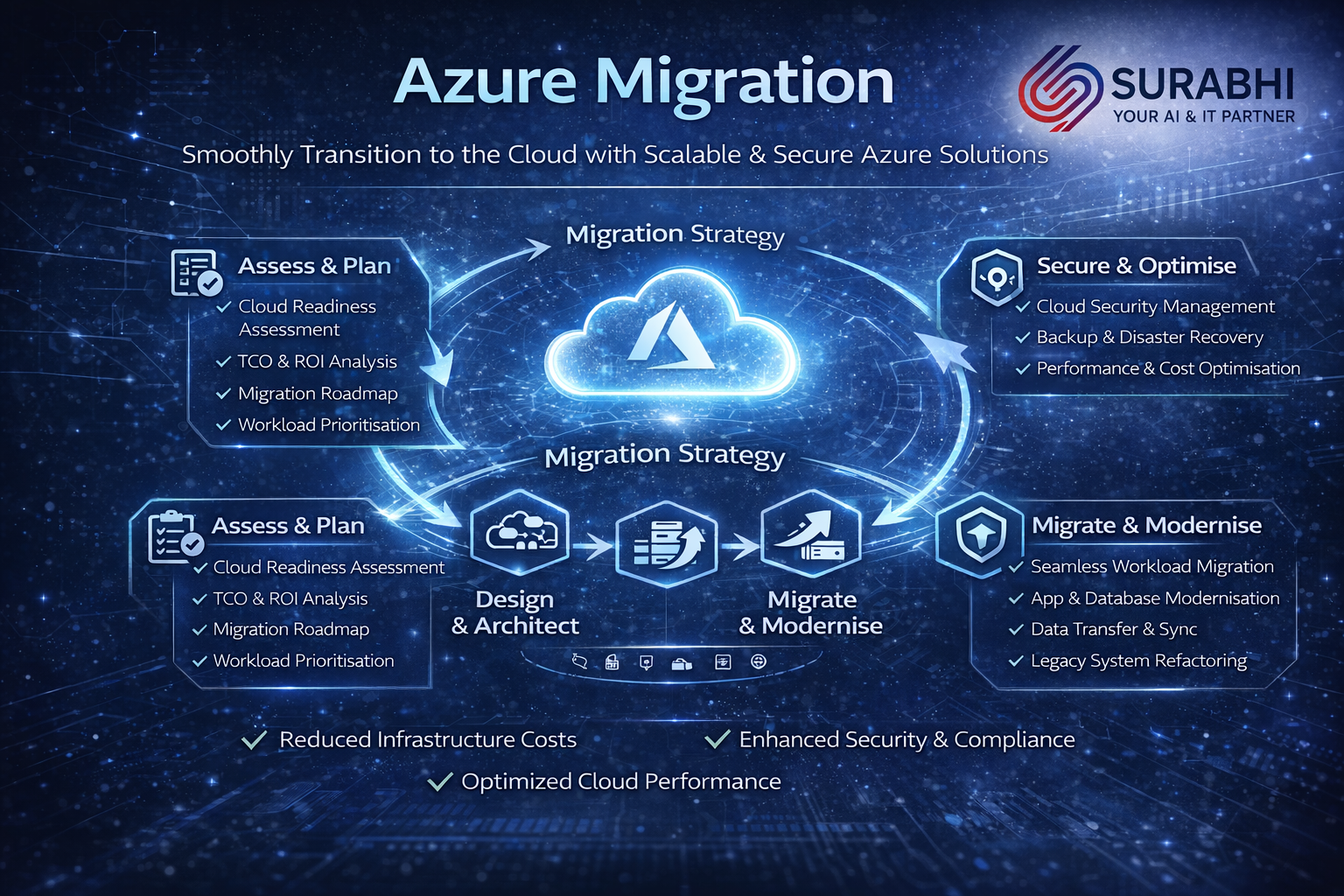
The Azure Migration Roadmap
Azure Migration follows a structured lifecycle beginning with assessment and planning, progressing through secure migration and validation, and concluding with optimisation and continuous improvement to maximise business value and cloud ROI.
Step 01
Assess & Plan
Conduct detailed workload discovery, dependency mapping, risk analysis, and cost modelling. Define migration strategy (rehost, refactor, replatform, or replace), establish governance frameworks, and design a secure Azure landing zone aligned with business objectives.
Step 02
Migrate & Validate
Execute migration using Azure-native tooling and automated pipelines. Perform data transfer, workload replication, configuration validation, and testing to ensure minimal disruption, performance integrity, and compliance adherence during transition.
Step 03
Optimise & Modernise
Refine performance, enhance security posture, and optimise cost structures. Implement monitoring, backup strategies, scaling configurations, and DevOps practices to ensure long-term resilience, agility, and measurable business value from Azure adoption.
Azure Migration – Frequently Asked Questions
What is Azure Migration and why should organisations consider it?
Azure Migration is the structured process of moving applications, data, and infrastructure from on-premise or other cloud environments to Microsoft Azure. It improves scalability, resilience, cost control, and compliance while enabling modernisation through PaaS, automation, and DevOps capabilities.
How long does an Azure Migration typically take?
The timeline depends on the complexity of workloads, legacy system dependencies, regulatory requirements, and data volumes. Small migrations may take weeks, while enterprise-scale transformations can span several months with phased rollout and validation stages.
Is Azure Migration secure and compliant for regulated industries?
Yes. Azure provides built-in security controls, encryption, identity management, monitoring, and compliance certifications. When combined with proper governance and landing zone design, it supports UK and global regulatory standards across finance, healthcare, and public sector environments.
What are the common migration strategies used in Azure?
Typical strategies include rehost (lift-and-shift), replatform, refactor, replace, or retire. The selected approach depends on cost, risk appetite, technical debt, performance goals, and long-term digital transformation objectives.
How can organisations control costs during and after migration?
Cost control is achieved through upfront assessment, right-sizing workloads, reserved instances, auto-scaling, and continuous monitoring. Post-migration optimisation ensures efficient resource allocation and avoids unnecessary overprovisioning.