


Feb 24, 2026
Measuring Organisational AI Maturity: A Practical Scoring Model
Executive Summary
Generative AI adoption is accelerating across UK financial services, energy, healthcare, retail, and public sector
organisations. However, deploying AI models in cloud environments without structured security controls introduces
significant regulatory, operational, and reputational risks.
A secure Generative AI architecture is not just about encryption — it is about
layered governance, traceability, accountability, and operational resilience.
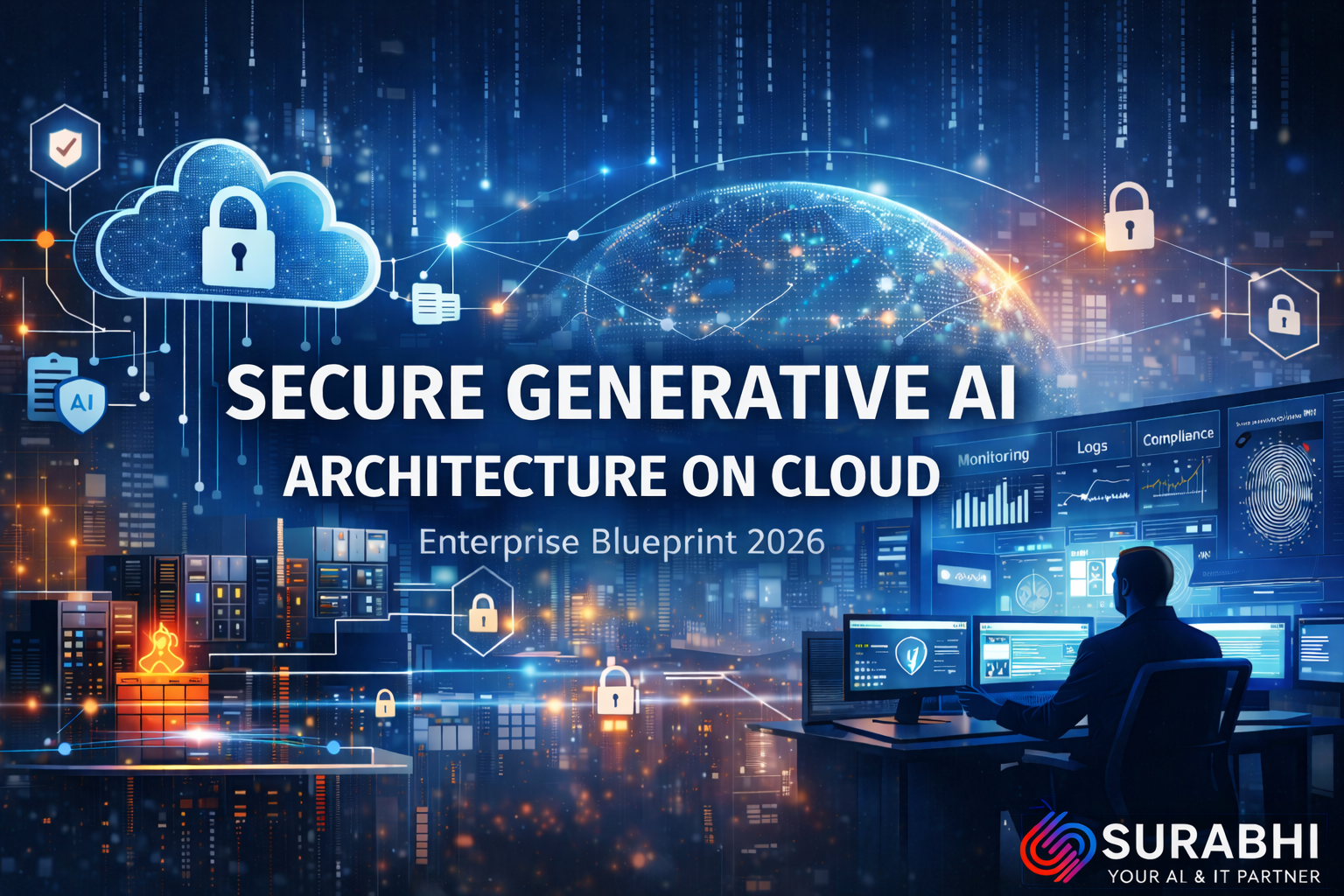
This guide outlines a secure, scalable architecture blueprint tailored for regulated industries in 2026.
Why Security Must Lead Generative AI Cloud Deployment
Unlike traditional applications, Generative AI produces non-deterministic outputs and interacts dynamically with
enterprise knowledge and workflows. Without strong controls, this can increase the risk of data exposure, prompt
injection, compliance breaches, and inaccurate outputs being trusted as “facts.”
In regulated environments, AI architecture must meet the same rigour as systems supporting financial controls,
critical infrastructure, and regulated reporting.
The 5-Layer Secure Generative AI Architecture Model
1) Business Application Layer
Typical implementations include:
- Internal knowledge assistants for regulated teams
- Regulatory reporting and documentation automation
- CRM / ERP copilots and guided workflows
- Service management or operations support tools
Recommended controls:
- SSO and MFA for all users
- Role-based access control (RBAC) aligned to data classification
- Session management and device posture (where applicable)
- User activity monitoring and logging
Design principle: No direct user-to-model access without controlled mediation.
2) Secure API & Gateway Layer
This layer enforces security boundaries between applications and models and is the primary control point for
identity, policy enforcement, and threat protection.
Critical protections include:
- Private endpoints (avoid public exposure by default)
- Web Application Firewall (WAF) and API security policies
- Rate limiting and throttling
- Token-based authentication and least-privilege scopes
- Prompt filtering, validation, and policy checks
- Input/output content moderation (aligned to organisational policy)
These controls reduce exposure to prompt injection, data exfiltration, and uncontrolled usage patterns.
3) Model Processing Layer
This includes:
- Hosted LLMs (enterprise-grade)
- Fine-tuned models (where appropriate and approved)
- Retrieval-Augmented Generation (RAG) pipelines
- Guardrails for system prompts and response policies
Security considerations:
- Dedicated tenancy / isolation where required by risk appetite
- Encryption at rest and in transit
- Environment segregation (Dev / Test / Prod)
- Model version control and approval workflows
- Controlled fine-tuning datasets with documented lineage
For regulated use cases, risk appetite often favours private connectivity and strong isolation over open public endpoints.
4) Data Governance & Classification Layer
This is the most critical layer in regulated environments because it governs what data the model can access, and under
which conditions.
Key controls include:
- Data classification, tagging, and policy enforcement
- Data Loss Prevention (DLP) integration
- Sensitive data redaction and masking
- Anonymisation pipelines for high-risk data sets
- Curated knowledge base indexing for RAG (approved sources only)
- Context window rules (what can/cannot be included in prompts)
Golden rule: Never allow unrestricted enterprise data exposure to generative models.
5) Monitoring, Logging & Compliance Layer
Security is not “set and forget.” Continuous oversight is required to remain audit-ready and to manage operational risk.
Monitoring should include:
- Prompt logs (with privacy-aware handling)
- Response logs and output risk signals
- Model performance metrics and quality scores
- Drift detection and re-validation triggers
- Bias and fairness monitoring (where relevant)
- Human override tracking and approvals
- Incident management integration (SOC workflows)
Audit artefacts typically include:
- Model cards and validation evidence
- Data lineage and access records
- Change logs (prompts, policies, models, datasets)
- AI risk register / RAID log
- Governance review records and decisions
Key Security Risks & Mitigation Strategies
Prompt Injection Attacks
Mitigation: Input validation, prompt sanitisation, policy-based guardrails, and content filtering.
Data Leakage
Mitigation: DLP integration, data redaction, sensitive data masking, and context restrictions.
Model Hallucination
Mitigation: Retrieval-Augmented Generation (RAG), approved knowledge sources, and human validation checkpoints.
Model Drift
Mitigation: Continuous benchmarking, performance dashboards, and scheduled re-validation.
Insider Risk
Mitigation: RBAC, segregation of duties, privileged access management, and activity monitoring.
Secure Cloud Deployment Options
Most regulated enterprises deploy Generative AI using combinations of:
- Private cloud AI services and private networking
- Dedicated tenant isolation for sensitive workloads
- Hybrid integration (on-prem or private data + cloud model layer)
- Centralised knowledge base governance supporting RAG
Architecture choices should align with your operational resilience standards, cybersecurity strategy, and enterprise risk appetite.
MLOps & DevSecOps Integration
Secure AI needs the same discipline as modern software delivery. Integrate your AI platform into:
- CI/CD pipelines and change management workflows
- Security testing and validation controls
- Vulnerability scanning and remediation processes
- Infrastructure-as-Code governance and policy-as-code
- Release approvals aligned to risk categorisation
Generative AI cannot operate as a side project. It must become part of enterprise DevSecOps and risk management.
Example: Secure Financial Services Deployment (Illustrative)
A UK financial institution implemented a private cloud AI assistant for compliance documentation and reporting support.
The architecture included a private API gateway, data masking and classification enforcement, human-in-the-loop review,
and full prompt/response logging.
Outcome after 6 months:
- 35% faster regulatory reporting preparation
- Zero data leakage incidents
- Audit-ready evidence packs and change control records
The key success factor was designing security architecture before scaling use cases.
Secure Architecture Checklist (2026 Edition)
- Private API endpoints and secure networking
- SSO, MFA, and RBAC aligned to data classification
- Encryption at rest and in transit
- DLP, redaction, and data masking controls
- Prompt logging and traceability
- Model validation and approval framework
- Monitoring dashboards and drift detection
- Human-in-the-loop governance for high-risk outputs
- Quarterly risk reviews and governance reporting
- Incident response integration (SOC processes)
If several of these controls are missing, the AI architecture may not be suitable for regulated production use.
What Regulators Expect in 2026
Expectations are rising around AI risk categorisation, governance evidence, accountability, and oversight. Organisations
should prepare for stronger scrutiny over how AI is controlled, monitored, and documented.
- Documented AI governance frameworks and risk ownership
- Evidence of human oversight for high-risk decisions
- Audit-ready documentation and traceability
- Security controls aligned to data protection obligations
Cloud AI security is no longer optional — it is increasingly a board-level responsibility.
Conclusion
Secure Generative AI architecture on cloud requires layered security design, governance-first thinking, continuous
monitoring, and integrated DevSecOps. Organisations that design architecture before scaling can innovate safely.
Those that rush deployments risk compliance breaches and reputational damage.
How Surabhi Consulting Supports Secure AI Deployment
We support regulated organisations with:
- Secure AI Architecture Design (HLD / LLD)
- AI Governance & Risk Frameworks
- Cloud Security Alignment and control implementation
- Audit-Ready Documentation Packs
- DevSecOps & MLOps Integration
Ready to deploy Generative AI securely in 2026?
Contact Surabhi Consulting for a Secure AI Architecture Assessment.
FAQ
Do regulated organisations need private endpoints for Generative AI?
Many do. Private networking reduces exposure and supports stronger policy enforcement. The right option depends on your
risk categorisation, data sensitivity, and operational requirements.
How do you prevent sensitive data from entering prompts?
Use data classification rules, DLP controls, redaction/masking, and application-level context restrictions. High-risk
use cases should include human validation and logging for auditability.
What is the purpose of the API gateway layer?
The gateway is the control boundary. It enforces authentication, rate limiting, prompt filtering, and logging, and helps
protect against prompt injection and misuse.
How do you keep AI outputs reliable?
Use curated knowledge sources and RAG, implement guardrails and validation workflows, and monitor performance continuously.
For regulated outputs, apply human-in-the-loop reviews.
What evidence is needed for audit readiness?
Maintain model documentation, data lineage records, prompt and change logs, governance decisions, and monitoring evidence,
including incidents and remediation actions.