
Feb 24, 2026
Measuring Organisational AI Maturity: A Practical Scoring Model

Post By
Abhijit Sen
Published
February 21, 2026
Introduction: Innovation Without Governance Is Risk
AI adoption across UK financial services, healthcare, energy, and public sector organisations is accelerating. From automated underwriting and fraud detection to predictive maintenance and generative AI copilots, transformation is happening at scale.
However, in regulated industries, AI introduces:
- Model risk
- Bias and fairness concerns
- Data protection exposure
- Operational resilience threats
- Regulatory scrutiny
With frameworks like the UK’s principles-based AI approach and global standards influencing governance expectations, organisations must demonstrate control, traceability, and accountability — not just innovation.
This blog outlines a structured AI governance framework tailored for UK regulated sectors, including measurable outcomes, implementation steps, and a real-world case example.
Why AI Governance Is Critical in Regulated Industries
Regulated industries operate under oversight from bodies such as:
- Financial Conduct Authority
- Prudential Regulation Authority
- Information Commissioner’s Office
- National Health Service
These organisations require firms to demonstrate:
- Clear accountability structures
- Transparent decision-making
- Data protection compliance
- Operational resilience
- Audit-ready documentation
Without governance, AI initiatives risk:
- Regulatory fines
- Reputational damage
- Biased automated decisions
- Uncontrolled model drift
- Security vulnerabilities
The key question is no longer “Should we adopt AI?”
It is “Can we govern AI effectively at scale?”
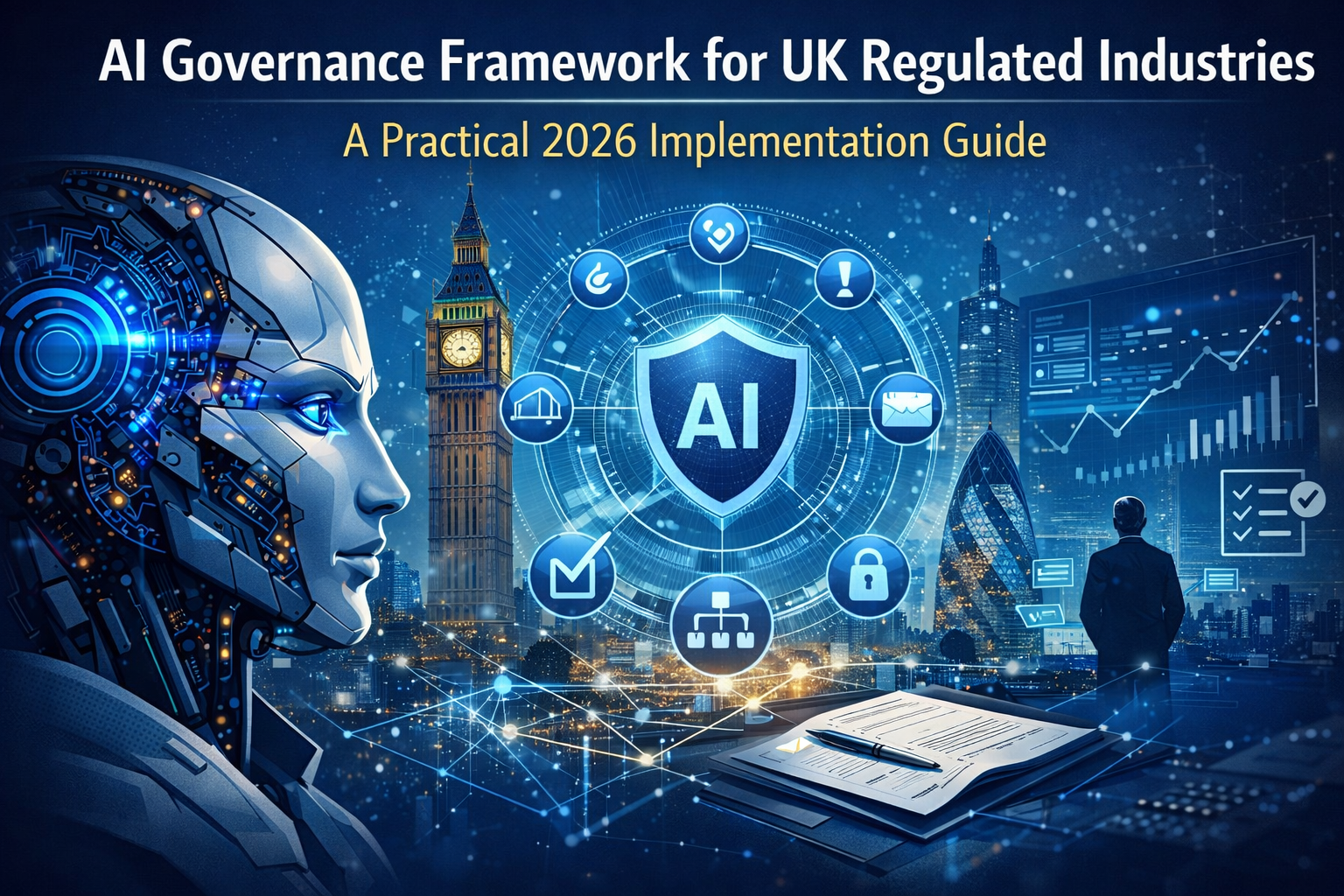
The 5-Pillar AI Governance Framework
Governance & Accountability Structure
Every AI initiative must have defined ownership.
This includes:
- AI Steering Committee
- Executive sponsor (CIO/CTO/CDO)
- Model Risk Owner
- Compliance oversight
- Data Protection Officer
Measurable outcome:
- 100% of AI models assigned an accountable business owner
- Formal RACI implemented across all AI use cases
Risk & Impact Assessment
AI systems must undergo structured risk evaluation before deployment.
Key assessments:
- Bias and fairness testing
- Data protection impact assessment
- Operational resilience review
- Third-party/vendor risk evaluation
- Ethical risk classification
Measurable outcome:
- 40% reduction in model-related incidents
- 60% improvement in audit response readiness
Data Governance & Quality Controls
AI models are only as good as their data.
Regulated sectors require:
- Data lineage tracking
- Quality validation controls
- Secure storage and encryption
- Role-based access management
- Data minimisation principles
Measurable outcome:
- 30% reduction in data integrity errors
- Improved GDPR compliance traceability
Model Lifecycle Management
AI governance must extend beyond deployment.
Lifecycle stages:
- Development validation
- Independent review
- Controlled deployment
- Ongoing monitoring
- Model retraining
- Decommissioning
Measurable outcome:
- 25% reduction in performance drift
- 50% faster model update cycles
Auditability & Documentation
Regulators expect evidence.
Documentation must include:
- Model design documentation
- Training data source log
- Validation reports
- Risk classification
- Version history
- Change approval records
Measurable outcome:
- 70% faster regulatory audit preparation
- Reduced compliance remediation costs
Implementation Roadmap: 3 Practical Phases
Phase 1: AI Maturity & Risk Baseline (0–3 Months)
- Identify all AI use cases
- Classify by risk tier
- Conduct governance gap analysis
- Define control objectives
- Establish AI governance policy
Deliverable:
AI Risk Heatmap + Governance Framework Blueprint
Phase 2: Control Implementation & Pilot Governance (3–6 Months)
- Implement RACI structure
- Deploy risk assessment templates
- Introduce model documentation standards
- Establish monitoring dashboards
- Train key stakeholders
Deliverable:
Governed AI Pilot Programme
Phase 3: Enterprise Scale & Continuous Monitoring (6–12 Months)
- Embed AI governance in PMO processes
- Automate model monitoring alerts
- Conduct an internal audit simulation
- Integrate governance into vendor onboarding
- Establish a quarterly AI oversight board
Deliverable:
Enterprise AI Governance Operating Model
Case Study: UK Financial Services Firm
Organisation Profile
Mid-sized UK financial services provider
£1.2bn AUM
Operating under FCA supervision
Challenge
The firm deployed AI-driven credit risk scoring and fraud detection tools. However:
- No centralised AI register
- Limited documentation
- Inconsistent bias testing
- No formal model ownership
An internal audit identified regulatory exposure risk.
Solution Implemented
Using a structured AI governance framework:
- Created AI model inventory register
- Established AI governance committee
- Introduced standardised risk classification
- Implemented quarterly bias testing
- Integrated monitoring dashboard
Results (Within 9 Months)
✔ 45% reduction in audit remediation findings
✔ 35% improvement in model transparency scores
✔ 60% faster regulatory information requests response
✔ 30% reduction in operational AI incidents
The organisation passed regulatory review with no material AI governance findings.
Common Pitfalls in AI Governance
- Treating governance as documentation only
- Over-engineering early-stage AI projects
- Ignoring vendor AI risk
- Failing to define accountability
- Lack of executive sponsorship
Governance must be proportional, risk-based, and scalable.
Key Success Metrics for 2026
Leading UK-regulated organisations are measuring:
- % AI models with documented risk classification
- Time to produce audit documentation
- AI incident rate per quarter
- Bias detection frequency
- Governance training completion rates
Mature organisations typically achieve:
- 30–50% reduction in compliance exposure
- 20–40% faster AI deployment cycles
- Significant audit cost savings
The Strategic Advantage of Proactive Governance
Organisations that implement AI governance early gain:
- Faster regulatory approval
- Increased stakeholder confidence
- Stronger operational resilience
- Competitive advantage in innovation
Governance is no longer a compliance cost.
It is a strategic enabler.
How Surabhi Consulting Can Help
Surabhi Consulting supports UK-regulated industries with:
- AI Readiness & Governance Assessments
- AI Risk Heatmaps & Compliance Frameworks
- Model Lifecycle Control Design
- AI Audit Preparation & Documentation
- Executive AI Governance Workshops
- PMO & Governance Integration
With over 20 years of experience across financial services, energy, healthcare, and public sector transformation programmes, we provide practical, audit-ready governance solutions tailored to UK regulatory expectations.
Final Thoughts
- AI innovation without governance introduces unmanaged risk.
- Governance without agility blocks innovation.
- The future belongs to organisations that balance both.
- If your organisation is deploying or planning AI solutions within a regulated environment, now is the time to establish a structured governance framework.
Ready to Strengthen Your AI Governance?
Contact Surabhi Consulting today to:
- Conduct an AI Governance Health Check
- Build a Risk-Based AI Framework
- Prepare for Regulatory Scrutiny
- Scale AI with Confidence
Book a consultation and transform AI from a regulatory risk into a strategic advantage.

Subscribe
0 Comments
Oldest