



Mar 06, 2026
Impact of AI in Iran’s War with the United States & Israel in 2026 — Lessons for Organisations Implementing Artificial Intelligence
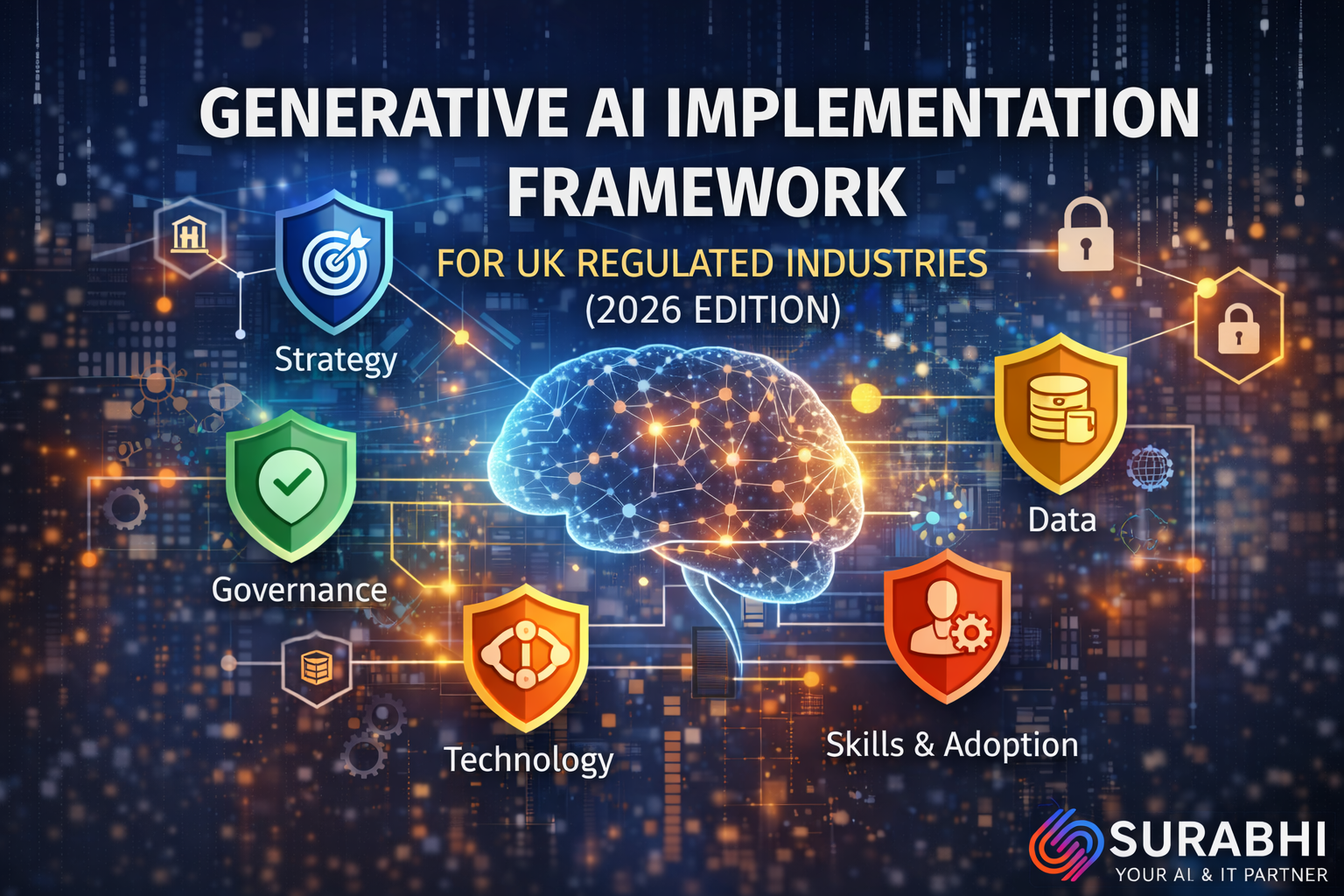
Generative AI Implementation Framework for UK Regulated Industries (2026 Edition)
Meta Title: Generative AI Implementation Framework for UK Regulated Industries (2026)
Meta Description: A governance-first roadmap for deploying Generative AI in UK regulated industries. Covering risk, compliance, secure architecture, ROI, and audit readiness.
Primary Keywords: Generative AI implementation UK, AI governance framework, regulated industry AI deployment, audit-ready AI, AI compliance UK.
Executive Summary
Generative AI has moved from experimentation to enterprise priority. In 2026, UK regulated industries—financial services,
energy, healthcare, retail, and public sector—are under pressure to innovate while meeting strict compliance and
operational resilience standards.
The reality: Generative AI cannot be deployed like a standard SaaS tool. It requires governance, risk
controls, secure cloud architecture, measurable ROI, and audit traceability from day one.
This guide provides a practical, governance-led framework to move from pilot to production—safely and sustainably.
Why Generative AI Requires a Different Implementation Approach
Unlike traditional automation, Generative AI produces non-deterministic outputs. It can hallucinate, introduce bias,
and increase privacy, security, and compliance exposure without the right controls.
For regulated industries, AI deployment is not just technical transformation—it is a
risk and accountability programme.
The 6-Stage Generative AI Implementation Framework
Stage 1: AI Readiness & Risk Assessment
Before implementation, organisations should assess:
- Data classification maturity
- Regulatory exposure
- Cybersecurity posture
- Operational resilience alignment
- Executive risk appetite
Key outputs:
- AI Risk Heatmap
- Use Case Risk Categorisation (Low / Medium / High)
- Governance Gap Analysis
Stage 2: Governance & Policy Design
A governance-first approach should align with:
- UK data protection expectations
- Internal compliance standards
- Operational resilience requirements
- Model accountability principles
Core governance artefacts typically include:
- AI Usage Policy
- Human-in-the-Loop Control Framework
- Model Validation & Approval Process
- Incident & Escalation Protocol
- AI RAID Register
Stage 3: Secure Architecture & Cloud Deployment
A secure enterprise AI architecture commonly includes the following layers:
- Business Application Layer
- Secure API Gateway
- Model Processing Layer
- Data Governance & Classification Layer
- Monitoring & Compliance Dashboard
Security controls should include:
- Role-based access control (RBAC)
- Encryption (at rest & in transit)
- Environment segregation (Dev / Test / Prod)
- Prompt logging & traceability
- Red-team testing and security validation
Stage 4: Controlled Pilot with Measurable KPIs
Pilots should be designed for measurable outcomes, for example:
- 30% reduction in reporting cycle time
- 20% reduction in compliance review effort
- Zero sensitive data leakage incidents
- ≥85% user adoption rate in target teams
Avoid vanity metrics (e.g., “number of prompts used”). Instead, define KPI baselines and compare against post-pilot results.
Deliverable: Pilot Evaluation & Risk Review Report
Stage 5: Enterprise Scaling & MLOps Integration
Scaling requires structured controls and operational integration, such as:
- Prompt version control and approval workflows
- Model performance benchmarking
- Drift detection and periodic re-validation
- Quarterly governance and risk reviews
- Continuous documentation updates
Generative AI should integrate into DevOps, change management, and risk frameworks—not operate separately.
Stage 6: Continuous Assurance & Audit Readiness
To remain audit-ready, maintain:
- Model cards and validation evidence
- Data lineage and traceability records
- Prompt library archives and change logs
- Human override and approval logs
- AI change management register
Regulators increasingly expect evidence—not intent. Audit readiness should be built into operating rhythms.
Managing Generative AI Risks in Regulated Industries
1) Hallucination Risk
Mitigate using Retrieval-Augmented Generation (RAG), curated knowledge sources, and validation checkpoints.
2) Bias & Fairness Risk
Use bias testing protocols and periodic model reviews. Document outcomes and remediation actions.
3) Data Privacy Risk
Implement strict data segregation, anonymisation controls, and access governance aligned to data classification policies.
4) Operational Risk
Integrate Generative AI into operational resilience, incident response, and business continuity management.
5) Reputational Risk
Ensure board-level oversight, clear accountability, and transparent governance reporting.
Industry Use Case Examples
Financial Services
- Regulatory reporting summaries and drafting support
- Compliance query assistants with controlled knowledge sources
- Risk scenario narrative generation for governance packs
Energy & Utilities
- ESG reporting automation and narrative drafting
- Incident documentation drafting with audit logs
- Maintenance report summarisation for operational teams
Healthcare Administration
- Operational documentation automation
- Policy summarisation and controlled knowledge assistants
- Service management and patient communications templates (non-clinical)
Retail & Supply Chain
- Demand forecast narrative reporting for leadership packs
- Supplier risk summaries and exception reporting
- Procurement documentation automation
Measuring ROI of Generative AI
ROI should be tracked across efficiency, cost, risk reduction, and governance metrics.
| Category | Example KPI |
|---|---|
| Efficiency | 35% reduction in documentation time |
| Cost | 18% operational cost saving |
| Risk | 25% fewer compliance errors |
| Revenue | Faster onboarding and decision cycles |
| Governance | 100% traceable AI decisions |
2026 Outlook: What’s Changing
- Increased regulatory oversight and audit expectations
- Greater board accountability for AI risk
- Stronger expectations around risk categorisation and evidence packs
- More agentic AI workflows requiring clearer human oversight
Organisations that embed governance early will scale safely. Those that deploy without structure risk regulatory intervention
and reputational damage.
Typical Implementation Timeline
- 0–3 months: Readiness & Governance Design
- 3–6 months: Secure Pilot Deployment
- 6–12 months: Controlled Scale & MLOps Integration
- 12+ months: Continuous Assurance & Optimisation
Conclusion
Generative AI implementation in UK regulated industries is not a race—it is a governance transformation journey.
Successful organisations combine structured risk management, secure cloud architecture, measurable ROI frameworks,
and continuous compliance alignment.
A governance-led framework transforms Generative AI from experimentation into an enterprise capability.
How Surabhi Consulting Supports Regulated Organisations
We support clients with:
- AI Readiness Assessments
- Governance & Risk Framework Design
- Secure Cloud AI Architecture
- Audit-Ready Documentation Packs
- Enterprise AI Scaling & MLOps Integration
Ready to implement Generative AI safely in 2026?
Contact Surabhi Consulting for a Generative AI Strategy Consultation.
FAQ
Is Generative AI allowed in regulated industries?
Yes, but deployment should include governance, risk controls, and compliance alignment—particularly around data protection,
accountability, and auditability.
How do you make Generative AI audit-ready?
Maintain model documentation, logging and traceability, validation evidence, change management records, and human oversight logs.
What is the biggest risk of enterprise Generative AI?
Uncontrolled data exposure and lack of accountability. Both can be mitigated by governance-first implementation and secure architecture.
How long does implementation take?
Many organisations deliver a secure pilot in 3–6 months, then scale over 6–12 months depending on use cases, governance maturity, and integration needs.
How do you measure ROI?
Track efficiency gains, cost savings, risk reduction, compliance accuracy improvements, and adoption—supported by baseline measurements and ongoing reporting.