

Mar 06, 2026
Impact of AI in Iran’s War with the United States & Israel in 2026 — Lessons for Organisations Implementing Artificial Intelligence

Automation & Process Intelligence
Automation and process intelligence streamline operations by combining workflow automation, AI, and real-time analytics. They reduce manual effort, improve accuracy, uncover inefficiencies, and enable data-driven decisions—boosting productivity, agility, and scalable business performance.
Key Benefits of our Automation & Process Intelligence approach
Key features of automation and process intelligence include workflow automation, real-time monitoring, AI-driven insights, and performance analytics. These capabilities streamline repetitive tasks, enhance visibility across operations, identify bottlenecks, and support smarter, data-led decision-making for continuous improvement.
01
Workflow Automation
Automates repetitive and rule-based tasks to improve efficiency and reduce manual errors.
02
Real-Time Monitoring
Provides live visibility into processes, performance metrics, and system activities.
03
AI-Driven Insights
Uses machine learning to detect patterns, predict outcomes, and recommend improvements.
04
Process Mapping & Analysis
Visualises end-to-end workflows to identify bottlenecks and optimisation opportunities.
05
Performance Analytics & Reporting
Delivers actionable dashboards and reports to support data-driven decision-making.
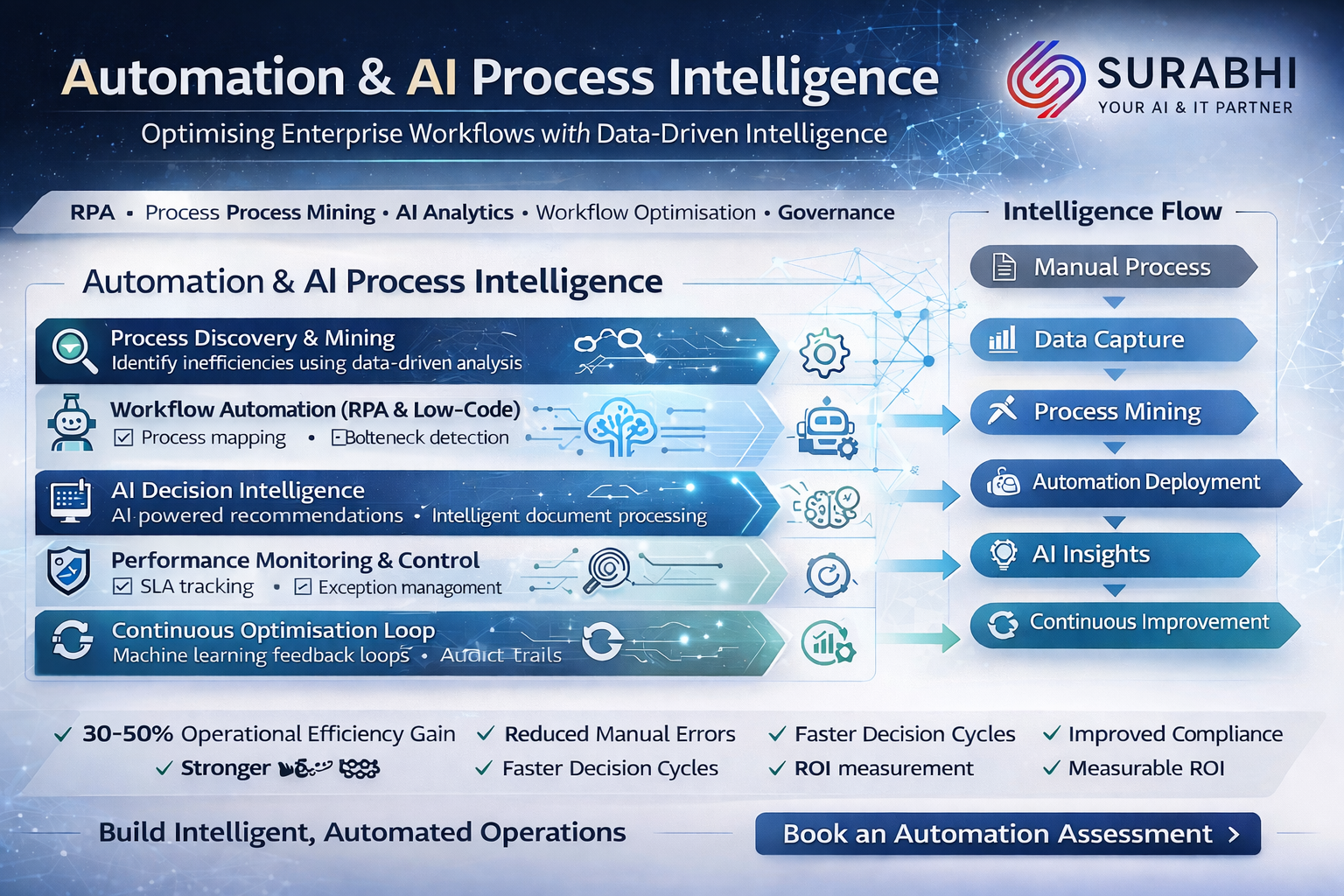
The Automation & Process Intelligence Roadmap
Automation and process intelligence work by capturing operational data, analysing workflows to identify inefficiencies, and automating repetitive tasks through predefined rules and AI models. The system continuously monitors performance, generates insights, and recommends improvements to optimise efficiency, accuracy, and overall business outcomes.
Step 01
Capture & Analyse
Collect operational data and map existing workflows to identify inefficiencies and bottlenecks.
Step 02
Automate & Optimise
Implement automation rules and AI-driven actions to streamline repetitive and manual tasks.
Step 03
Monitor & Improve
Continuously track performance, generate insights, and refine processes for ongoing efficiency and growth.
Automation & Process Intelligence – FAQs
What business processes can be automated?
Repetitive, rule-based, and data-driven tasks such as approvals, reporting, onboarding, finance operations, IT service management, and compliance workflows.
How does process intelligence add value beyond automation?
It provides real-time visibility, identifies bottlenecks, uncovers inefficiencies, and delivers predictive insights for continuous optimisation.
What technologies are typically used?
Robotic Process Automation (RPA), AI/ML models, workflow orchestration tools, process mining platforms, and analytics dashboards.
How do you ensure governance and compliance?
Through audit trails, role-based access controls, data protection measures, and alignment with regulatory and industry standards.
What ROI can organisations expect?
Improved productivity, reduced operational costs, faster turnaround times, enhanced accuracy, and scalable performance improvements.